ORIENTATION TO THE VISUAL
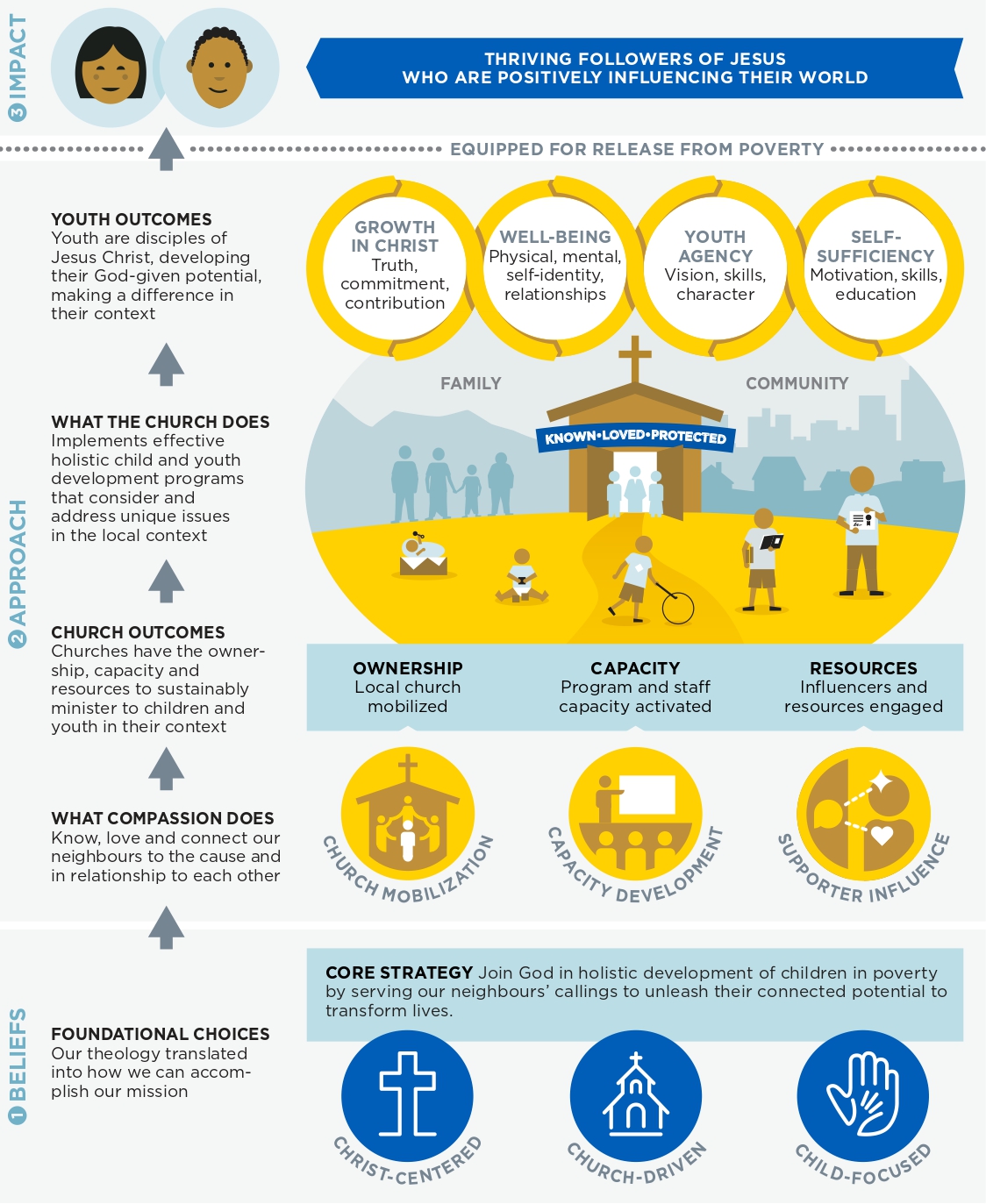
The Theory of Change visual reads from bottom to top and conveys a logical path toward enabling our impact on children in poverty. It translates our beliefs into a well-informed, actionable approach.
Documentation, including our Global Outcomes Framework, exists outside of this summary to further describe concepts within the Theory of Change.
EXPLANATION OF THE THEORY’S LOGIC
Foundational Choices Compassion’s biblical understanding of Christ, the Church and the Child shapes all that we do. Christ’s love and grace enable change. The Church is God’s instrument to change the world. Children are created in God’s image; additionally, it is a strategic choice to focus on children. In light of this, we propose how we can best advance our mission through our Core Strategy.
What Compassion Does Compassion plays an essential role of connecting relationships. We do this because we believe God works in and through people and their connections with each other. Our work is to facilitate a network of caring individuals both local and far away, who Compassion works to know, love and connect in order to protect and enable positive development in children and youth who live in contexts of poverty. We depend mainly on local connections to surround the child, build church capacity to minister and help deepen supporter influence. We depend on far-away connections to provide needed financial support and share different cultures, interests and personalities that expand the possibilities a child might see for themselves. Local and distant connections work together to enable children to thrive.
Church Outcomes Churches that are effective in holistic child and youth development ministry share certain attributes. These include ownership, capacity and engaged resources. These characteristics enable churches to evaluate their context and select relevant programs to address the realities of children in their care.
What the Church Does Church partners receive support from Compassion’s national offices to understand their own vision and plans for children and youth. Together they assess needs in their own local context. The church considers the state of children and youth, families and the community at large. They use local perspectives, community data, inputs from families and youth, Compassion data, and more to identify priority areas. These priorities are addressed through localized programs to advance toward Youth Outcomes in age-appropriate ways.
Youth Outcomes These are the holistic attributes we believe make it possible for a young person to be released from poverty and reflect a thriving and abundant life in Christ. They enable youth to pursue their full potential and make positive differences for others so they, too, thrive. Growth in Christ, well-being, youth agency, and self-sufficiency are key themes within the Youth Outcomes. We believe that child protection is an essential condition that enables progress toward these Outcomes.
Impact Compassion’s aspiration is to see children from a context of poverty grow into adults that thrive as they follow Jesus to actively influence positive change in their world. Thriving refers to a sense of flourishing or ongoing healthy growth and development. We believe this is the abundant life Jesus mentioned in John 10:10 and is only fully enabled through a personal relationship with Him. As an individual thrives, they seek to act for the benefit of others to change negative circumstances around them. Such influence might be in the home, with extended family, through the church, in the broader community, across the nation or beyond. This contribution is the natural outflow of a transformed life that is holistically released from poverty and into Kingdom purpose.